
A concrete densifier is a clear, penetrating liquid that reacts with free lime in a concrete slab to form calcium silicate hydrate (C-S-H). Its application makes the surface denser, more abrasion-resistant, and easier to polish. Atlanta Concrete Coatings applies densifiers on polished concrete projects across Metro Atlanta to improve durability before sealing the slab.
Unsealed concrete is only about 20% to 30% as hard as it could be since the curing process leaves roughly 70% of the free lime inside the slab chemically unreacted. A densifier pulls that unused chemistry back into the equation and completes the reaction that water alone can’t. Across Gwinnett County warehouses, retail storefronts, and Buford garages, the same slab reliably tests harder on the Mohs scale once a proper concrete densifier is added.
What a Densifier Actually Does to Concrete
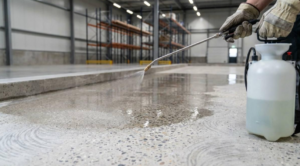
A densifier is a water-thin liquid sprayed onto the slab during polishing. It penetrates the concrete’s open pores and reacts with calcium hydroxide, the leftover lime left behind by cement curing. That reaction forms calcium silicate hydrate (C-S-H), the same compound that gives concrete its structural strength.
Microscopic voids that would otherwise collect dust, absorb stains, and wear away under foot traffic get filled in by the new crystal growth. As a result, the finished floor is denser, tighter, and noticeably harder at the surface. This is why our concrete polishing and finishing services include densification as a baseline step on every commercial slab we polish.
The Chemistry: Lithium, Sodium, and Potassium Silicate
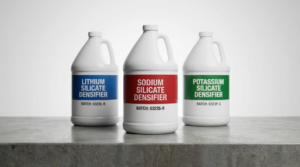
Densifiers come in three main chemistries: lithium silicate, sodium silicate, and potassium silicate.
- Lithium penetrates deepest and leaves the smallest byproducts, which is why it’s preferred on high-end retail and polished-concrete floors.
- Sodium formulations are more aggressive but can leave a white surface residue if over-applied.
- Potassium sits in the middle and cures faster on hot Atlanta slabs.
All three work by reacting with the slab’s own chemistry rather than sitting on the surface. That’s why densifiers are classified as reactive densifiers, not sealers. They don’t film over, peel, or strip off the way a topical coating can, and they don’t stop vapor from leaving the slab.
Where a Densifier Fits in the Polished Concrete Process
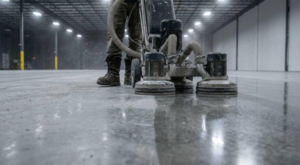
Polished concrete is produced in a sequence of grinding passes that starts with coarse metal-bond diamonds and ends with fine resin-bond diamonds. The densifier is applied between the transitional and honing passes, usually after the 100- to 200-grit step. Hitting it too early wastes chemistry on a surface that’s still being ground away; hitting it too late leaves dust and open pores that should already have hardened.
Once the slab has absorbed the densifier and cured for the manufacturer’s recommended dwell time, the final polishing passes bring the surface to a satin or mirror-level shine. For the full grinding and polishing sequence, see our Atlanta concrete polishing guide.
When a Densifier Is the Right Call (and When It Isn’t)

Densifiers belong on any polished concrete project where long-term abrasion resistance matters: warehouse floors, retail showrooms, restaurants, and higher-end garages. They’re also valuable on grind-and-seal jobs where the owner wants the slab to resist dusting before the sealer goes down.
Where densifiers don’t belong is under an epoxy or polyaspartic system. Epoxy primers need mechanical porosity to bond, not a chemically densified surface. If a slab is going to receive a full epoxy floor system, we skip the densifier step and focus on diamond-grind profiling and moisture testing instead.
Frequently Asked Questions
How long does a concrete densifier take to cure?
Most lithium and potassium densifiers set within four to eight hours of application, though full chemical reaction continues for up to 72 hours. Atlanta Concrete Coatings waits the full manufacturer-specified dwell time before the next polishing pass so the crystals finish growing inside the slab rather than being ground off.
Is a concrete densifier the same as a concrete sealer?
No. A densifier reacts chemically with the concrete, becoming part of the slab and hardening the surface from within. A sealer is a film that sits on top of the floor and forms a barrier against moisture or stains. Polished concrete jobs typically use densification first, then an optional topical sealer for extra stain protection.
Can I apply a densifier to an old concrete slab?
Yes, densifiers work well on existing slabs in Metro Atlanta warehouses, offices, and older homes. The surface usually needs grinding first to open the pores and remove curing compounds or previous coatings. Once the surface is clean and porous, the densifier penetrates and reacts with the lime that’s still inside the slab.
Find Out Which Floor System Makes Sense for Your Space

The choice between a densified, polished floor and a fully coated floor usually comes down to aesthetics and the type of traffic that the floor will receive. Polished and densified slabs give you a low-maintenance, dust-free surface that wears gracefully over decades without peeling or recoating. Epoxy gives you color and pattern options you can’t get from bare concrete, along with a chemical-resistant surface.
Atlanta Concrete Coatings polishes and coats concrete floors across Atlanta, Georgia, for residential, commercial, and industrial clients. Contact us for a free on-site assessment and a recommendation that fits your space.