Auto Shop Epoxy Flooring in Atlanta, GA: What Service Bays Need
Atlanta Concrete Coatings works with Auto Dealerships & Service Centers as one of the facility types it serves, alongside its broader commercial concrete coatings work across the Atlanta metro area. For a service bay, the floor has to stand up to daily vehicle traffic, fluid exposure, and a lot of wear, while still giving technicians a safe, easy-to-clean surface to work on. Atlanta Concrete Coatings offers commercial concrete coatings, epoxy flooring, 100% solids epoxy, moisture vapor barrier systems, broadcast flake or quartz systems, polyaspartic coatings, polished concrete, and concrete grind-and-seal, all of which can factor into the right system for a service bay.
What a Service Bay Actually Puts on a Floor

Before any coating is recommended, it helps to look honestly at what the bay deals with every day. A useful evaluation generally covers:
- Vehicle and rolling-equipment traffic throughout the day
- Point loads from lifts, jacks, and stands
- Dropped tools and impact in active work areas
- Exposure to automotive fluids such as oil, fuel, and coolant
- Cleaning products and routine wash-down or wet conditions
- How long the bay can realistically be closed for the project
Comparing systems against these factors, rather than assuming one epoxy floor is the same as another, is what separates a floor that performs from one that struggles under daily shop use.
Why Floor Preparation Matters as Much as the Coating
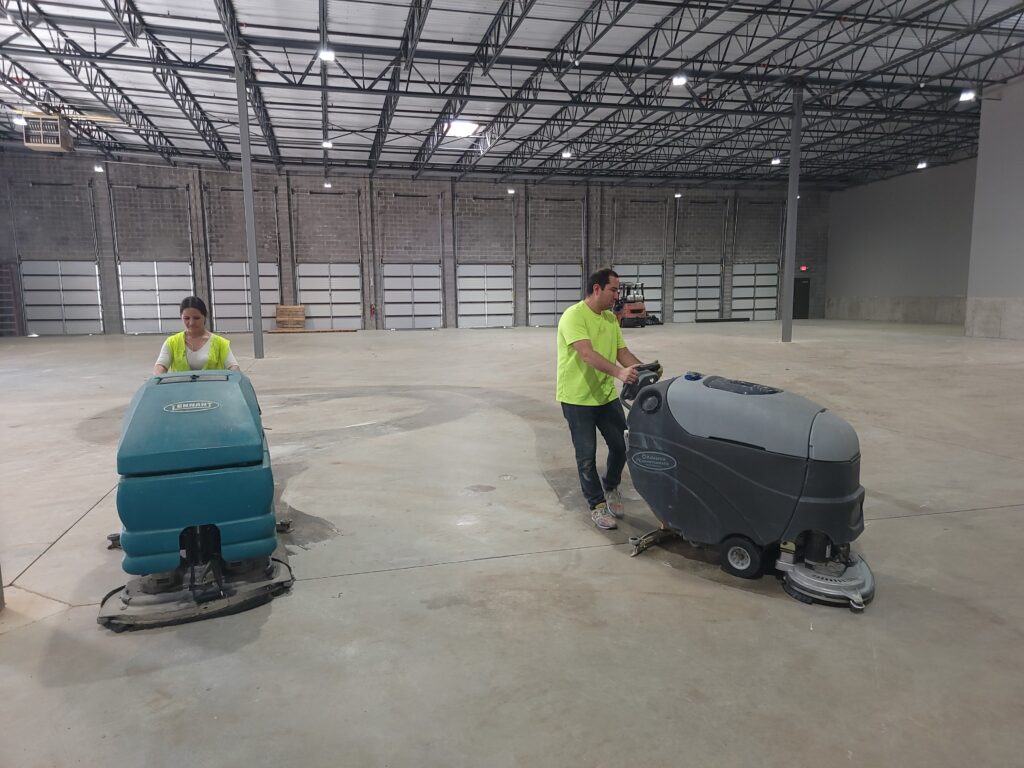
A coating is only as good as what is underneath it. Atlanta Concrete Coatings’ published installation approach includes concrete assessment, mechanical diamond grinding, crack repair, and surface profiling, followed by moisture testing, epoxy application, and a protective topcoat. For a service bay specifically, this preparation stage is where oil contamination, old coating failures, and slab cracks get addressed before a new system goes down.
Moisture is part of that evaluation. Moisture inside a concrete slab can contribute to resinous-flooring failure, which is why in-situ relative-humidity testing, covered under ASTM F2170, is a meaningful step before flooring goes down. Skipping this kind of check is a common reason coatings in high-moisture conditions bubble or peel later, as outlined in Atlanta Concrete Coatings’ piece on common epoxy floor problems.
Epoxy or Polyaspartic: Which Fits the Bay’s Schedule?
Material choice often comes down to how the shop balances downtime against durability needs. Atlanta Concrete Coatings’ comparison of epoxy versus polyaspartic coatings describes polyaspartic as faster-curing and more UV-stable, while 100% solids epoxy with a protective topcoat is presented as the primary option when impact and chemical durability are the priority.
| Priority | Where It Tends to Lead |
|---|---|
| Minimizing bay closure time | Faster-curing, more UV-stable polyaspartic |
| Maximum chemical and impact durability | 100% solids epoxy with a protective topcoat |
| Added traction where fluids or wash water collect | Broadcast flake or quartz system built into the chosen coating |
Texture is its own decision point. Broadcast aggregates can improve traction in areas where fluids or wash water are present, but the finish still needs to stay workable for the shop’s regular cleaning routine, so it is worth discussing alongside the base material.
What Affects the Investment
Atlanta Concrete Coatings’ published Atlanta-area guidance places epoxy flooring between $4 and $9 per square foot, with preparation requirements, moisture conditions, and the selected finish all affecting where a project lands in that range. Two quotes at the same price per square foot are not necessarily the same scope. It is worth confirming that a quote accounts for:
- Oil-contamination removal from the existing slab
- Crack repair and any needed concrete repairs
- Mechanical preparation, such as diamond grinding
- Moisture evaluation before the coating is applied
- The texture or finish being specified
- What the return-to-service window looks like for the bay
Leaving any of these out of a comparison can affect adhesion, safety, how disruptive the project is, and the total cost once work begins.
Frequently Asked Questions
What should an auto shop evaluate before choosing an epoxy floor system?
Traffic patterns, point loads from lifts and jacks, fluid exposure, cleaning routine, traction needs, and how much downtime the bay can tolerate.
How do concrete moisture and oil contamination affect an epoxy service-bay project?
Both can affect how well a coating bonds to the slab. Moisture testing and contamination removal during preparation are part of addressing this before the coating goes down.
When does a faster-curing polyaspartic option make more sense than an epoxy-based system?
When minimizing bay closure time and UV stability matter more than maximizing chemical and impact durability.
Get a Service Bay Floor Evaluation in Atlanta
If you manage a service bay in Atlanta, Buford, or the surrounding metro area and want a floor system matched to your actual shop conditions, Atlanta Concrete Coatings can evaluate your space and walk through the options. Call (770) 906-6992 to start the conversation about your facility’s flooring needs.